Bryan Hooper has worked closely with Angus Nivison over many years, from his time at Coventry Gallery through to the present at Utopia Art Sydney. As a gallerist, collector and friend, he has witnessed the development of Nivison’s practice at close range, observing its gradual shifts and enduring concerns across decades of making. This long-standing relationship has been shaped not only by professional collaboration, but by ongoing conversations about painting, process he many ideas, experiences and observations that find their way into the work.
In this conversation, Hooper and Nivison come together to reflect on the artist’s evolving work over more than fifty years. Moving between memory, material and method, their exchange offers insight into the changing nature of Nivison’s practice, while also revealing the continuity that underpins it. Grounded in a shared history of looking, thinking and dialogue, the interview unfolds as both a critical reflection and a personal account of an artist’s sustained engagement with painting.
Bryan Hooper
“I thought we might structure this decade by decade. Let’s start at the beginning— Tell me about the first group show you ever had, or the first show you were in?”
Angus Nivison
“The first would have been my graduating show. The first commercial group show was a fundraiser at Coventry, and then one with Ann Lewis at Gallery A. That was the first proper show.”
BH
“What influence did Ann have on you as an impressionable young painter?”
AN
“A big one. She took me on, never really said why, but she gave me crucial advice. I was deciding whether to stay in Sydney or return to my parents’ property where I would be able to build a studio. She said, “Everybody needs somewhere to make, even if you don’t use it all the time, it’s somewhere that’s yours.” That changed everything. I went back and set up at Yalgoolygum.”
BH
“And you were balancing that with working full time on the family property?”
AN
“Yes. Early on it wasn’t too hard, when I was single. I painted in the shearing shed, though I had to clean it up before each shearing. Once I built the studio, I worked at night. That continued after I married and had kids. I’d go into the studio after they went to bed.”
BH
“And can you recall how much pressure you were under when you had a deadline, when you had a show coming up?”
AN
“Back then, I worked best under pressure. Now I procrastinate more. I remember my mother coming into the studio and nothing would have happened, and I would still be reading the newspaper or something, and she’d say, “If you’re any lazier you’d suffocate!” A bit unfair, I thought.”
BH
“Moving into the 80s, you had your first solo show at Gallery A. What sort of work was in that show?”
AN
“Very representational. Almost hyper-real landscapes, minutely detailed. The complete opposite of what I do now. I believe there were geese drawings in it, but I’m not sure.”
BH
“And during that time, during the 80s, you had several shows at the Bloomfield Gallery in Sydney, also Standfield Gallery in Melbourne.”
BH
“But across all this time the landscape has always remained central? Not necessarily traditional landscape painting, but you wanted to paint about landscape?”
AN
“Yes. It’s where I live, and so it’s always my starting point. But I was never interested in just describing it. I wanted something more. Through landscape, I realised you could express emotion and engage with the human condition. That became the main driver.”
BH
“One thing that’s very noticeable about your career as a whole is that you chose to stick with acrylic paint throughout.”
AN
“That was pragmatic. I had young children in the studio and didn’t want fumes. Acrylic was quick, I had limited time in the studio at the beginning of my career, so I needed something that dried fast. It’s not as luscious or sexy as oil, but I like that it’s unforgiving. What you put down is what you get.”
BH
“I would argue that you perhaps have found the secret to acrylic after four decades.”
AN
“A slow learner, maybe.”
BH
“Oh no, you look at a lot of indigenous masters, they know about their paint, and I think you do as well. Now also during that those first years, you seem to have worked extensively on paper. Now also during those first years, you seem to have done a lot of work on paper.”
AN
“Yeah, I did – and I’m not sure why. I just started using watercolour. Maybe because at that early stage I was still working directly from the landscape. I would take stretched paper onto a board and take it out to some little place and at least get the sketches done. And sometimes some painting on the spot, and watercolour was expedient.”
BH
“Well its actually stood you in good stead because quite honestly, over the years that I’ve known you, works on paper have been just as important as the canvases.”
AN
“I don’t make a distinction between paper and canvas really. What I learn from the works on paper goes over to the paintings on canvas and what I learn in making the bigger paintings comes back to the paper, the two feed each other. The lovely thing about having a small piece of paper is you can be quite brave, because it’s not a big expenditure. You can just see what happens. For me that doodling is the beginning of an idea.”
BH
“So in the 90s there was a big change.”
AN
“My work started to become less literal, absolutely. And I think that I was starting to feel more sure of myself and more clear on what I wanted to do.”
BH
“And you also joined the Coventry stable.”
AN
“Maybe that’s what gave me the confidence. Channy was showing a lot of quite ‘out there’ work, and it’s hard to say exactly what shifted, but the space itself had an impact. It was such a generous environment, and they really allowed me to expand. I remember thinking, ‘I need to fill this — I want to fill it.’ That’s when the scale of the work really started to grow, during my time at Coventry.”
BH
“From my knowledge, or memory, the 90s is fairly important in terms of the first multi-panel paintings starting to appear. The one that springs to mind is ‘Hard Rain‘.”
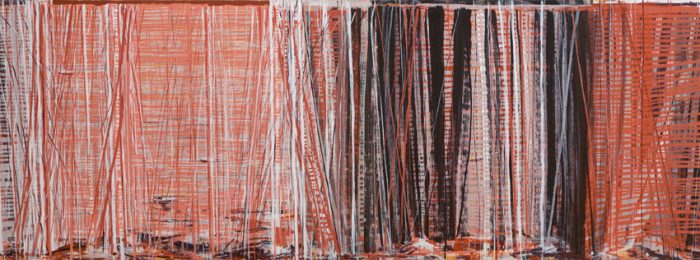
Hard Rain, 1995
AN
“That was a very important painting for me. It was the first really major large work I sold, and it gave me a sense of confidence, a feeling of, ‘OK, I can do this.’ Up until then, I’d assumed the larger works would just end up in storage, but this one didn’t. That shifted something.
The person who bought it, Bill Burge, was someone I’d met a few years earlier. At the time, he’d told me quite directly, ‘I really don’t like your work at all,’ and I’d said, ‘Oh, fine, Bill.’ I think he was a bit miffed by that. But when he bought this painting, he said, ‘Ha ha, Angus, I have to admit, I’ve changed my view.’ It was a lovely moment, and we formed a friendship from there.
People who are prepared to take a punt on difficult, large paintings are incredibly important, they are valued.”
BH
“Through the 90s you seemed to shift between abstraction and figuration. Was there any particular reason?”
AN
“No, I just I just enjoy drawing things. And I can do that. I have those skills and every now and again they come out. During that time the work was more idea paintings, the landscape at this stage was not that important anymore.”
BH
“If we go through the paintings from the end of the Coventry years into the 2000s, there seem to be references to the landscape, but not as obvious. I am thinking about the weather. There are so many paintings with weather references in their titles. There were works around that time, where you were reading the sky.”
AN
“I’m obsessed with weather. Being on the land, really that’s all you’re talking about. Rain is the lifeblood for farmers, not that I was a farmer, but my brother was a farmer and he very kindly gave me a bit of work.
But the weather, I’m still obsessed with it. I just love that idea of the skyscapes.”
BH
“Towards the end of the 90s, you started painting a series that you were calling late 20th century landscapes. And there were quite a few in that series. They were all diptychs. What was behind that? What was behind the theme?”
AN
“It was the turn of the century, and I found myself wondering how we were all going. In many ways, and this connects to what I’m doing now, my feeling was: not too well. There’s a strong sense of nostalgia in those paintings, but it’s not sentimental. It’s tied to a feeling that things are beginning to slip, to backslide, politically, socially.
There was a nostalgia for the twentieth century, just as it was about to disappear, but also a more uneasy awareness that things were on the verge of changing irrevocably, particularly in relation to climate. The title felt right because it held that tension between a kind of longing for what was, coupled with a nervousness about what’s to come. There’s a melancholy in it, and I’ve always been drawn to that. Melancholy has its own kind of beauty — though, of course, so does happiness.”
BH
“Happiness is good too! Was “Late Burn Ascending” the culmination of that series?”
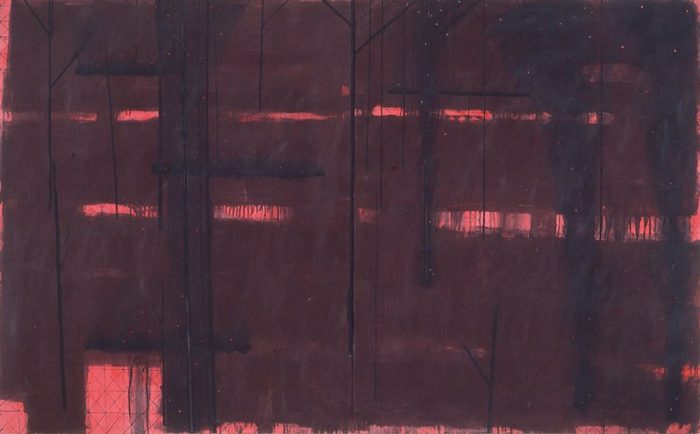
Late burn – ascending, 2000
AN
“It was — and it was also a kind of farewell to Channy Coventry. A very important painting for me, very heartfelt, almost like a reflection of his spirit. Channy came from the land, and he carried that connection with him, and I felt that something of that was coming to an end.
It also ties to the idea of late burns, those winter burn-offs that used to happen in winter. They’re not done as much anymore; it’s become an old fashioned practice.”
BH
“It’s an Indigenous thing.”
AN
“Well, it’s becoming recognised again now. Those older generations had learnt from First Nations people, and it worked, there was a knowledge there. So it all ties in: a sense of ending, of Channy’s passing, his spirit rising, and you see that in the painting, in these small details. It’s a beautiful work, one of my favourites, actually, but a large part of that is because it’s grounded in the land, and in those layers of connection and memory.”
BH
“And then the new century starts. After a couple of years with a relatively new gallery, you joined Utopia Art Sydney. And in that ensuing period, there was quite a big event.”
AN
“I won the Wynne!”
BH
“Yes, with a beautiful painting called “Remembering Rain”. Where again, the grid started to appear.”
AN
“The title Remembering Rain was a reference back to Hard Rain. When that painting was included in the NGA Federation exhibition, I went down to see it — and there it was, hanging alongside all the heavy hitters. It held its own, and I remember thinking, ‘maybe I should have stayed with that a bit longer,’ because I’d only made two works on paper from it before moving on. I tend to do that.
So there’s a sense, with this work, of returning to that earlier ground — but coming back to it with a bit more confidence, a bit more bravery.”
BH
“There’s a lot more of the underpainting revealed in this work than we’d seen before.”
AN
“Well, the studies for those were really just cloud paintings — quite different. I remember when I finished it, I actually rang John MacDonald and said, ‘I think I’ve done a good painting.’ And maybe I had. The rest is history.”
BH
“In 2004, you had your first exhibition at Utopia Art Sydney, where you paid a kind of homage to one of your heroes — All the Places I’ve Never Been. It wasn’t overt; on one level it was quite subtle, but on another it carried a more direct resonance.”
AN
“Well that would be Ian Fairweather.
There’s always a little bit of Fairweather in my work, the painters I’m drawn to tend to find their way in, Rothko of course is an obvious one as well and Godfrey Miller – I respond to that sense of structure, of line.. And “All the Places I’ve Never Been” is also an homage to the world itself, having not travelled extensively, and instead imagining much of it through nature documentaries and travel programs on television.”
BH
“You’ve made up for it since. The painting that I remember from the early part of this century was a painting called Silence. That’s the first painting of yours, I can recall, that made me pay attention to your surfaces.”
AN
“It’s a well named work. It’s full of silence, that painting. And It’s very much got that Rothko-ness about it, his surfaces are amazing. It’s got lots of other things in it as well.”
BH
“This work seemed to be a turning point. Did you see it as that?”
AN
“Yes, I did. I stopped — or rather, I changed pace. I began thinning the paint, so the work became more about soaking and layering. It was also a painting that wasn’t crowded; there were areas where very little happened, and I think that’s important. There’s a subtlety in that work that wasn’t there in the earlier ones.”
BH
“Then there was another painting that happened in about 2005 called “The Language of Mountains is Rain”. And that that seemed to be a fairly big departure for you.”
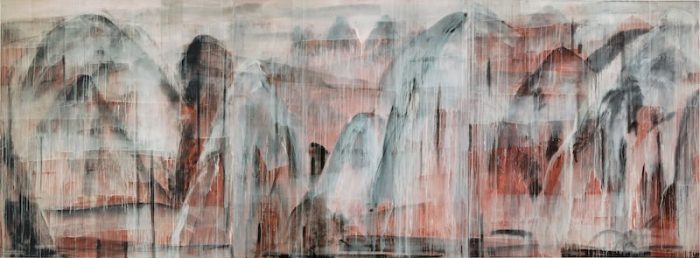
The Language of Mountains is Rain, 2005
AN
“I have a real fondness for that painting. Around that time, Caroline had undergone a hip operation so I was travelling back and forth to Sydney while she was in rehab. Driving down the escarpment along the Gloucester Way, I was constantly moving through mist and mountains, and that landscape slowly seeped in. Then, when she came home, I just sat down and made the painting.”
BH
“Was that the first time gesso really became important in the work — and also charcoal?”
AN
“I’d used gesso before, but this was probably the first time it became dominant. And yes, there was a heap of charcoal — although it’s ironic, because it reads almost like ink.”
BH
“And you handled the charcoal in a very particular way — it never quite settles into black. It feels quite diaphanous.”
AN
“Not in that one, no — it’s more smudged. But yes, diaphanous is a good word.”
BH
“In 2006, you made a couple of major works that ended up in significant collections. One was Glimpse, acquired locally.”
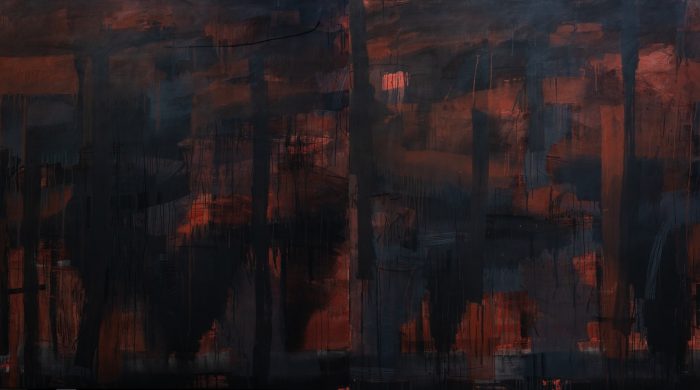
Glimpse, 2006
AN
“Yes! That was purchased by the Friends of NERAM. It was a big moment. They’d collected smaller works over time, and then finally saved to acquire a major painting.”
BH
“And all of a sudden the Art Gallery of New South Wales decided you must be okay and acquired Uncertain Light”
AN
“Yes, and I never really expected that. It wasn’t something I pushed for — it just happened. In many ways, Glimpse and Uncertain Light are a pair; they’re both circling the same ideas.
We live in uncertain times, uncertain climates, and those concerns are present in the work. It’s striking how relevant they still feel now, particularly in relation to conflict in the Middle East. Uncertain Light, especially, carries something of that, there’s almost a suggestion of minarets in it. It draws together questions of climate, instability, and global turmoil. Perhaps I watch too much news — I don’t know.”
BH
“There was a bit of fire in the picture, a sense of heat coming off it.”
AN
“There was, around that time I was also making a smaller work called Two Degrees and a larger one called One Degree. They were about rising temperatures, about the world heating up, burning up.
Climate has always been there for me, because I’m from the country. But those were the first paintings where it became overt — and, in a way, the first successful ones.”
BH
“That led into a very productive period — though quite a different one. Around 2008, there was a painting called Fallen.”
AN
“That was one of the hardest paintings I’ve ever made. It took a long time, and at one point I gave up on it entirely. Then I went overseas with Annie Lewis and Caroline — Annie took us to a show in Philadelphia, and on to Pittsburgh, where the Andy Warhol Museum is. From there we went out to Falling Water, and seeing that was a turning point. I suddenly understood how to resolve the painting I’d put aside. If I hadn’t made that trip, that work would never have come into being.”
BH
“It’s very interesting because it’s probably one of the toughest paintings you could have painted.”
AN
“It harks back a little to Bridge — there’s that strong, almost weighty grid holding everything together. Seeing the cantilevering at Falling Waters helped me understand that structure. I remember thinking, ‘Ah — I get it. I know what to do.’ and if you look at that painting close up its industrial, it’s got acres of charcoal, you can see there’s a struggle going on.”
BH
“There’s a tension in it that I hadn’t really noticed in a lot of your paintings before that.”
AN
“I couldn’t settle on a title for it. Barry Pearce came up to look at the work, and I said, ‘What am I going to call this, Barry?’ He said, ‘Fallen,’ and I knew immediately — that was it. It just fitted.
Later, when I saw the painting at Tamworth Regional Gallery, it struck me as quite dark at first. But then I realised — it wasn’t dark at all. It was entirely about light. That really surprised me.”
BH
“Around the same time — perhaps a little later — there was that single-panel painting, Impenetrable Light. It just carried these traces of light. It was in the same show, and it really held its own.”
AN
“Yes — and in terms of influences, there’s a nod to Colin McCahon in that one.”
BH
“McCahon does come to mind with some of your work. And then there was Harbinger, another strong single panel — again circling similar concerns, really, around climate.”
AN
“Absolutely. By that point it was right at the forefront of my thinking — what are we doing? The sense of inaction, of governments dithering — it’s so bloody obvious. And the paintings were getting darker and darker.”
BH
“And all of a sudden after a trip to Japan comes A song.”
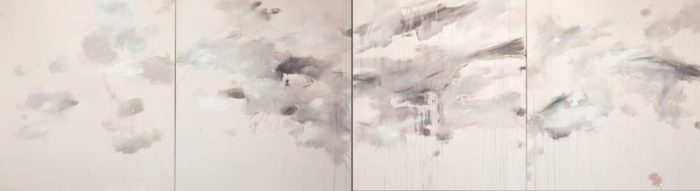
A Song, 2012
AN
“And lightness — a complete shift in palette. It was in autumn, very hot, and there was this kind of chemical haze drifting across from China. We were travelling to an art festival on the Inland Sea, reaching the islands by ferry, and everything was held in this soft, enveloping fog — forms just appearing and disappearing. That’s really where it began. A lot of those paintings come out of that experience”
BH
“There was a whole group of paintings from that Vestige series where colour seems to emerge out of whiteness.”
AN
“Yes — and I think it was a bit of a relief, for everyone, to see that lightening of the palette. It was also a very happy time, and I think that feeling found its way into the work.”
BH
“And after that came the four-panel painting The Four Seasons — another departure.”
AN
“It was — a real celebration of colour. And it came out of music, really — Bach, in a broad sense. I’d seen Gerhard Richter’s John Cage paintings and thought, that’s a compelling idea — to paint in response to music. I went into a CD shop thinking I should properly listen if I was going to paint it. I came across Vivaldi’s Four Seasons — which I’ve always loved, even when it wasn’t particularly fashionable — and asked for a recommendation. There were hundreds of recordings, but the guy suggested a new reinterpretation by Max Richter. I took it home, and it was a revelation. I’ve been a fan ever since.”
BH
“Bach seems to be a constant for you.”
AN
“He is — I listen to Bach all the time. I’ve seen the sheet music, and it’s incredibly dense. You look at it and wonder how anyone could play it, and yet it sounds so simple. I love that contradiction.”
BH
“And that relates to your painting — that idea of less is more.”
AN
“Yes, and that goes right back to the National Art School and Sid Ball. He once said to me, ‘Australian painters put too much into their paintings.’ I said, ‘That’s because they think the buyer wants value for money.’ And he said, ‘Yes, but it’s not always a good idea.’ I’ve held onto that. We were talking about Silence — that was the first painting where there was space, where not much seemed to be happening. Of course, there was a lot going on, but visually it was calm.”
BH
“It was a very meditative work.”
AN
“It is. In many ways it’s like being alone in the bush in the evening, when everything feels still. But it’s not actually silent — that’s the thing. The space opens up, and suddenly you become aware of all the sound. People from the city come and stay and say, ‘It’s so noisy at night’ — they hear all the birds.”
BH
“And then 2015 brought a pretty important painting — Poet.”
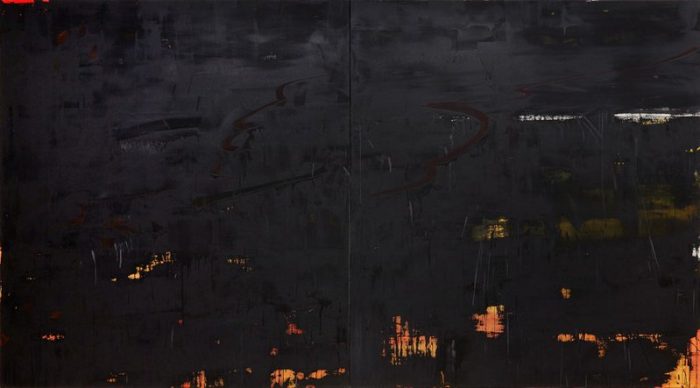
Poet, 2015
AN
“Yes — that really came out of nowhere. I remember being quite astonished when I painted it. I thought, ‘this is one that will never sell,’ but I was very excited by it. It came out of that process of scraping back through the paint — and also from this artgraph tool Caroline had given me for Christmas years earlier. It had just been sitting there, and I kept thinking, ‘what am I going to do with that thing?’
Then I finally picked it up and began scraping it through the wet paint, and it revealed these faint traces of colour. There was a kind of calligraphic quality to it — something that could almost read as Middle Eastern.”
BH
“A painting of great beauty and surface.”
AN
“Hence the name. I love poetry.”
BH
“And it’s probably your most poetic work.”
AN
“I think so.”
BH
“In a very beautiful way because even though it’s a black painting it’s a beautiful painting.”
AN
“That was one of those paintings where I was simply there with it — completely present — and then it was finished. I remember thinking, ‘how did that happen?’”
BH
“To be quite honest, for me, it eclipsed all the other paintings in that show.”
AN
“Yeah, I agree.”
BH
“And it was, a very good show!. Then we come to the following year, 2016 — and suddenly there’s this surge of red. Not burgundy, not muted or flat, but something much more direct — very present, very much in your face.”
AN
“That’s interesting, because the red had always been there — just in small amounts. In Poet, for instance, it’s there, but only in tiny traces. In Remembering Rain, it sits underneath — beneath those very bright greens and that intense, almost orangey red. That’s often how the paintings begin: layered like that, then scraped back. But this time I didn’t do that.
This painting is really about red. Perhaps there was a degree of anger in it — a response to the way things are going in the world — I’m not entirely sure. But at the same time, I’ve always found red to be a deeply beautiful colour.”
BH
“They didn’t come across as angry pictures. They are basically just red and white.”
AN
“Yes — it’s very simple, but it says a lot with very little. That’s something I really love.”
BH
“It keeps on coming back to less is more.”
AN
“Yes. And I think at that time, I wasn’t sealing the paper with gesso, I think I was willing to just let the paint soak in. So that was a challenge. They were always sealed before. And it was about the same time I stopped putting gesso on canvas, painting just straight onto the canvas.”
BH
“And how does that affect the work?”
AN
“Well the canvas is hungry. So…”
BH
“They use a lot more paint?”
AN
“About the same amount of paint but in thinner and thinner layers, so you get that soaking.”
BH
“When you’re painting, do you let the layers dry?”
AN
“Yes — sometimes I keep working straight through, and other times I’ll let it dry for a day, especially if I want a bright colour to sit beneath a darker layer. In the more recent work, you can see that happening — the underlying colour coming through. So they seem dark but they are actually very colourful.”
BH
“The next show had a great picture, back to rain again. “Good rain knows when to come.”
AN
“Yeah, and that’s such a true saying. I must have nicked it from somewhere, but I don’t know where.”
BH
“And that picture just happened out of the blue again.”
AN
“Yes — but all of that is always there, sitting in the background. I stopped drawing from what’s in front of me and started working from what’s here.” (gestures to chest) “That’s probably why the work shifts — one moment it sits in a certain place stylistically, and then suddenly it moves somewhere else. I’ll follow an idea, and that leads to another, and then another.”
BH
“And then you do odd projects like the Arboretum group of works.”
AN
“Well, I loved that – that was just so left field – Angus Nivison’s flower paintings?”
BH
“And how did that come about?”
AN
“It was part of a program — I think funded by Arts New South Wales — pairing artists with museums. I was initially matched with the Museum of Antiquities. I rang and asked if I could visit, and they said, ‘Sorry, everything’s packed away — we’re renovating.’ They offered to send photos, but I said, ‘No — I’m not painting from photographs.’ I thought, well, that’s that — I’ll be out of it.
But then they came back with a different idea and suggested the Herbarium. I had no idea what that even was at the time.”
BH
“Could you please explain to us what it is.”
AN
“It’s where all the dried plant specimens are kept — pressed between sheets of paper and carefully stored. Every species: some extinct, some newly discovered — hundreds of thousands of them. By the time I finally got there, I was quite delayed; it had taken a long time to organise with the University, so I had a very limited window to work.
Because it’s a climate-controlled environment, nothing could be brought in that might contaminate or damage the collection. Everything had to be frozen first — the paper, even the paint tubes — and once they were inside, they couldn’t come back out. So I had to work in there, in the cold, under fairly intense conditions. And of course, all the scientists were watching — which added a certain pressure.
The whole place is about preservation and storage, so I decided to layer two specimens together in each work, to create a more complex, unfolding narrative. That caused some concern — they said, ‘You can’t do that, it has to be one specimen.’ And I said, ‘I’m not a scientist, I’m an artist — I can do what I like.’ And, to their credit, they agreed.
So I began working across different scales — small specimens, larger ones — and each drawing became a kind of story: about the person who collected it, and about what has happened to it, and its environment, since.”
BH
“And they were quite beautiful.”
AN
“I mean Josephine’s Sunshine was basically a love story. I have never painted a love story before.”
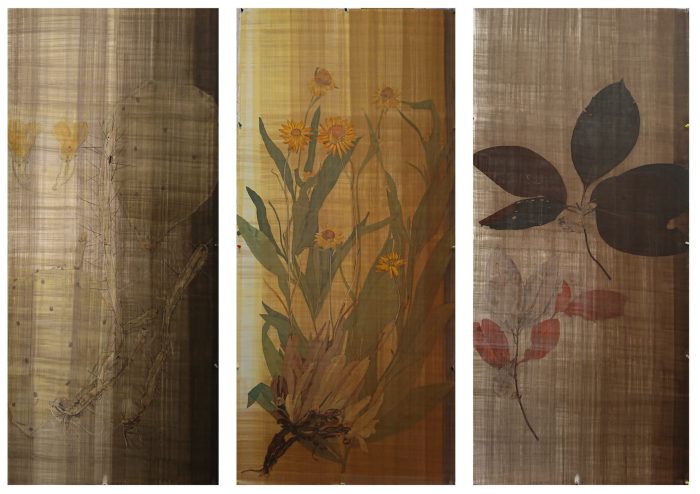
Jeremy’s Voice — Invasion’, ‘Josephine’s Voice — Sunshine’, ‘Leichhardt’s Voice — Shroud’, 2021
BH
“What about A Gift?”
AN
“Yes, that’s a love story. The painting was a gift for my wife Caroline.”
BH
“The painting that is sitting behind you. That came out of another project with NERAM about the gorge country?”
AN
“I think it was called Sun Showers and Kangaroo Grass. At the time, I wasn’t particularly interested in returning to the gorge country — I’d worked there a lot, and I’d moved away from painting literal landscapes.
I had this project where I had to go out and draw on site, which I hadn’t done since the Coventry days. To be honest, my heart wasn’t really in it. But I pushed through that, and when I brought the drawings back to the studio and developed them into paintings — particularly that last one — I realised I didn’t want anything literal, just the impression of being there.
The turning point was going back in the rain. The first day had been dry and sunny, and I remember thinking, ‘this feels like going backwards — I don’t want to do this again.’ But in the rain everything changed. The landscape was transformed — it was beautiful, it was veiled.”
BH
“What I find interesting about that project is that, quite suddenly, these orbs begin to appear in the work. They’d surfaced occasionally before — in the Paris paintings, in Two Moons — but here the circular forms really start to assert themselves.”
AN
“Yes — I think they probably came from reading too much Murakami. There are two moons in one of his novels, and I remember thinking, ‘wouldn’t it be great if we had two moons?’ That’s how they first crept in. But then I became really interested in the circle itself. I’m not entirely sure why — perhaps because it feels so complete.
And it was also different — it broke away from that usual up-and-down, across-the-surface structure. It opened up another space, another way of thinking within the work.”
BH
“It’s interesting that those circular forms begin to appear during that period, and then by around 2020 you return to the grid with a work like Different World, where the circle is not a dominant element.”
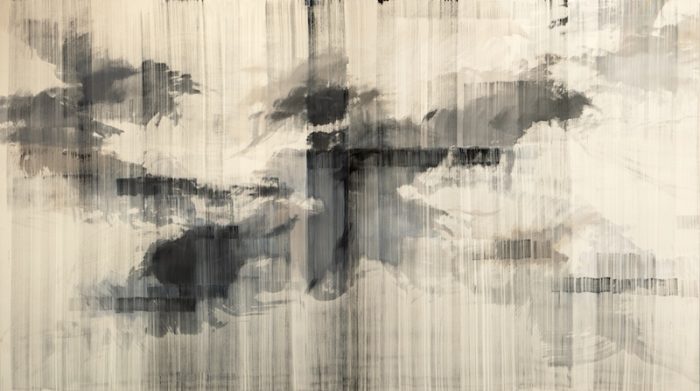
Different World, 2020
AN
“No — there wasn’t a circle in that one at all. And that was quite unusual painting process for me. Normally I begin with small drawings, but with that painting I went straight in — I had a very clear idea that the world had shifted. It felt like It’s both the same and not the same — there’s something in it that almost reads like a map of the world, but nothing is quite in the right place. And those vertical movements have a kind of barcode quality. There’s a lot going on in it.”
BH
“And it’s a pretty good picture. I pulled out one of the panels in the storage unit the other day, and I thought, “This is fantastic”.
AN
“I think that’s because it was something of an outlier within that show. It was quite different from the other works. I tend to do that — I get an idea, and I just follow it when it excites me.”
BH
“That’s a painting well worth revisiting. And then, in your most recent exhibition, the circle really comes to the fore — becoming the dominant geometric form.”
AN
“Yes — it had been there for a while, building, and then I finally gave into it. It became dominant. Some of those paintings carry a slightly ominous tone — a sense that something is approaching, some kind of reckoning. I wasn’t sure what it was exactly, just that it felt large, and inevitable.”
BH
“If you think about it, the circle could also relate to things like droplets — water falling, that kind of form.”
AN
“Yes, exactly — circles are everywhere in nature. You’re quite right. They were always present in the work in some way, but at a certain point I decided to bring them forward, to make them more explicit.”
I think it really came out of the natural world — the sun, the moon — those kinds of forms. And then it shifted into something else. In a way, those large circular paintings gave me a way to move entirely away from the literal. I wanted that whole exhibition to be completely abstract.”
BH
“And that really took you away from the real world.”
AN
“Yes — it freed me from constantly referencing nature. In a way, it became about what the painting itself could do — about emotion, and about beauty. There was a great deal of beauty in those works, and I think beauty is an underrated quality.
One of the wonderful things about non-representational painting is that the viewer, in a sense, owns it. They bring their own story to the work; they don’t need an information panel to tell them what to think. They get to make up their own minds.”
BH
“And your work, certainly this century, has always had that quality.”
AN
“Yes — it’s definitely moved in that direction.”
BH
“In that sense, the viewer is essential to completing the painting.”
AN
“The viewer is absolutely the crucial part of what I do. Because if no-one looks at these works, what’s the point?”